
Data Centres Matter More Than Ever

Behind almost every digital service we use is physical infrastructure. From cloud computing and artificial intelligence to banking, communications and everyday business applications, data centres have become an essential foundation of the modern digital economy.
For most people, the digital world feels almost invisible.
We store information in the cloud, join video meetings from anywhere, stream content instantly and increasingly use artificial intelligence to perform tasks that would have seemed impossible only a few years ago.
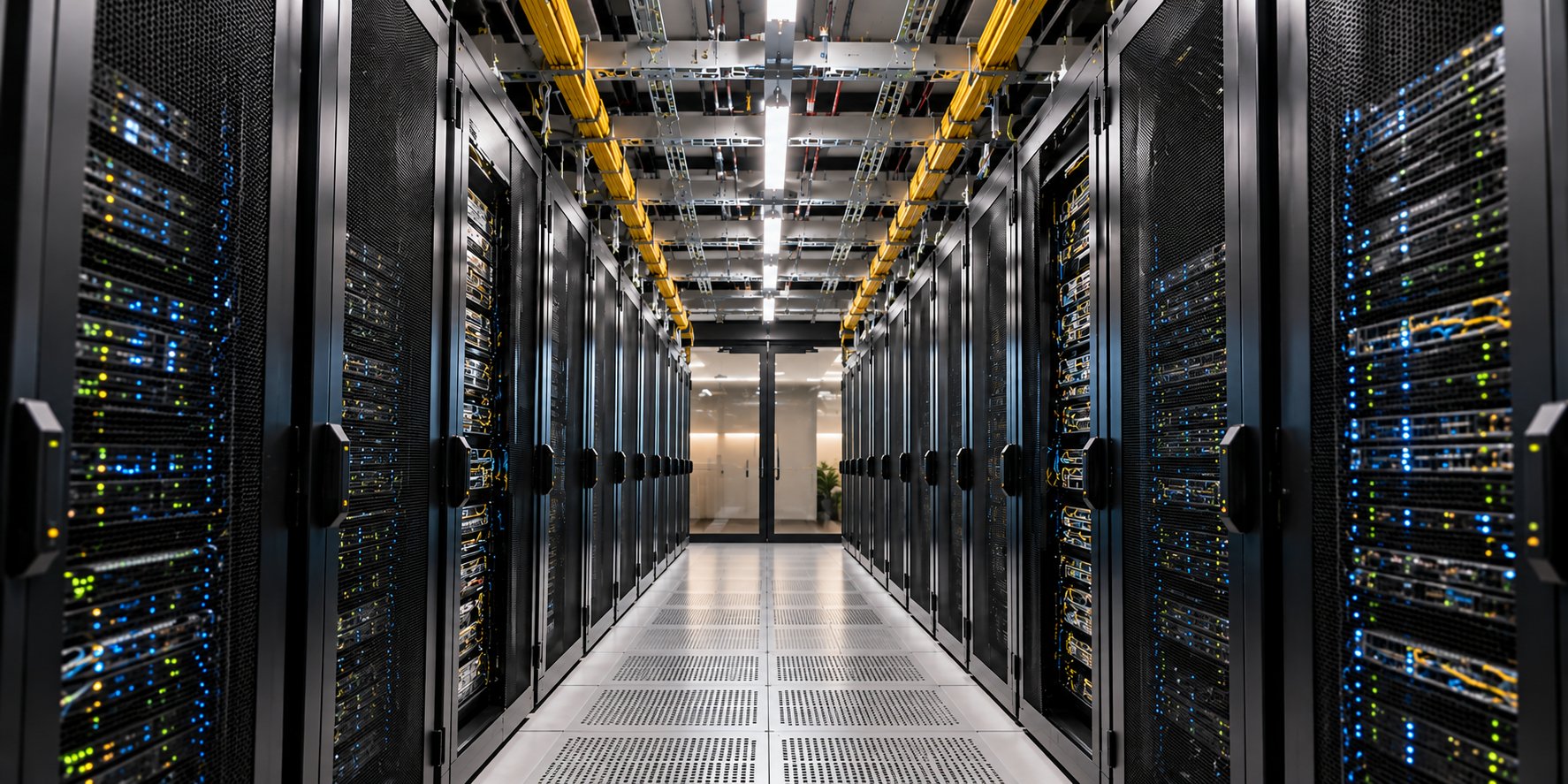
But none of these technologies exist entirely in the cloud. Behind them are physical facilities containing servers, storage systems, high-capacity fibre networks, power infrastructure, cooling systems and thousands of individual connections working together around the clock.
Data centres are becoming increasingly important as the world’s demand for computing and connectivity continues to grow.
The physical infrastructure behind our digital world
Every time information is stored, processed or transferred, infrastructure is involved.
A cloud application may appear on a laptop or smartphone within seconds, but behind that simple interaction can be servers operating inside a data centre, fibre networks connecting facilities across countries, telecommunications networks delivering the information to users and sophisticated systems maintaining power, cooling and security.
Modern data centres bring these technologies together within highly controlled environments. Inside them are servers and storage systems, networking equipment, fibre-optic connections, uninterruptible power supplies, backup generation and cooling infrastructure. As society becomes more digital, the importance of this physical layer continues to increase.
AI is accelerating demand
Artificial intelligence is adding another dimension to data-centre growth. Training and operating advanced AI models requires significant computing capacity. This is driving the deployment of increasingly powerful processors and high-density computing environments.
According to the International Energy Agency (IEA), data centres consumed approximately 415 terawatt-hours of electricity in 2024, equivalent to around 1.5% of global electricity consumption. The IEA projects that consumption could more than double to approximately 945 TWh by 2030, with AI identified as the most important driver of that growth alongside increasing demand for other digital services.
This means the AI revolution is not simply a software revolution. It is also an infrastructure revolution. More computing capacity requires more facilities, more power, greater cooling capacity, higher-density networks and increasingly sophisticated connectivity between servers, data halls and geographically separated data centres.
Connectivity is at the heart of the data centre
Computing power alone is not enough. A data centre must be able to move enormous quantities of information quickly and reliably. That makes telecommunications and fibre infrastructure fundamental to its operation.
Within a modern facility, thousands of physical connections may link servers, switches, storage systems and other equipment. Beyond the building, high-capacity fibre networks connect the data centre to other facilities, cloud platforms, telecommunications networks and ultimately the end user.
As computing environments become larger and faster, installation quality becomes particularly important. Cable containment, fibre routing, termination, patching, labelling, testing and documentation all contribute to an infrastructure environment that can be operated, maintained and expanded effectively.
Reliability has become essential
Data centres are expected to operate continuously. Businesses increasingly depend on digital platforms for communication, financial transactions, logistics, manufacturing, customer services and everyday operations. Even relatively short interruptions can therefore have significant consequences.
Modern data-centre infrastructure is designed around resilience. Redundant power supplies, backup systems, diverse network connections and carefully engineered cooling environments help reduce the risk that a single failure will interrupt critical services. The same philosophy extends to network infrastructure: correct installation, testing and commissioning are essential because problems within the physical network can ultimately affect the services operating above it.
The energy challenge
The growth of data centres also presents one of the industry’s biggest challenges: energy. Data centres already consume substantial amounts of electricity, and AI-oriented facilities can require significantly greater power density than conventional computing environments.
The IEA projects that global data-centre electricity demand could reach approximately 945 TWh by 2030. It also estimates that around 20% of planned data-centre projects could face delays if electricity-grid constraints are not adequately addressed.
This is changing how new facilities are planned. Location, grid availability, renewable energy, cooling efficiency and overall energy performance are becoming increasingly important considerations alongside computing capacity and connectivity. The challenge is therefore not simply to build more capacity, but to build capacity that can operate efficiently and sustainably at scale.
Europe is preparing for significant growth
Data-centre infrastructure has also become strategically important for Europe. AI, cloud computing and digital sovereignty all depend on access to sufficient computing capacity.
The European Commission has stated that data centres are essential to Europe’s digital future and is seeking substantial growth in European data-centre capacity while placing greater emphasis on sustainable facilities. Europe is also investing in dedicated AI computing infrastructure through AI factories and proposed large-scale AI gigafactories.
These ambitions will require more than servers. They require buildings, electricity, cooling, telecommunications networks, fibre infrastructure, security systems and skilled engineering teams capable of delivering and maintaining increasingly complex environments.
Security matters too
As data centres become more important, protecting them becomes equally important. These facilities can contain business-critical and sensitive information while supporting services used by thousands or millions of people.
Security therefore operates on several levels. Cybersecurity protects systems and information, while physical security protects the facilities and equipment themselves. Access control, CCTV, monitoring and controlled operational procedures can all form part of the wider security environment. Resilience and security are becoming inseparable from performance.
Building for what comes next
The next generation of digital services will place even greater demands on physical infrastructure. AI will continue developing. Cloud adoption will expand. Businesses will generate more data. Connected devices, automation and increasingly digital industries will require greater computing and network capacity.
Exactly what the digital world will look like ten years from now is difficult to predict. What is much easier to predict is that it will require infrastructure.
Behind every AI application, cloud platform and digital transaction will continue to be physical networks and facilities making those services possible. Data centres are therefore becoming more than buildings filled with technology. They are becoming part of the critical infrastructure supporting the digital economy.
And as our reliance on digital technology continues to grow, the engineering, connectivity and physical infrastructure behind those facilities will matter more than ever.

Latest thinking • Industry Insights .